Why the best schools don’t keep their expertise to themselves
When teachers in Australia mentor and collaborate with fellow educators in cities and communities across the globe, the mutual benefits ripple through entire school communities.
When teachers in Australia mentor and collaborate with fellow educators in cities and communities across the globe, the mutual benefits ripple through entire school communities.
As Head of Mathematics at Haileybury, Australia’s largest school, Jason Fischer’s working day is busy. However, for the past nine years he’s carved out time to mentor colleagues at schools in China, Indonesia, Vanuatu, Vietnam and Papua New Guinea.
Jason is one of a number of senior school teachers at Haileybury and Haileybury Rendall School in Darwin who are part of an extensive transnational program that has been in operation for more than 20 years.
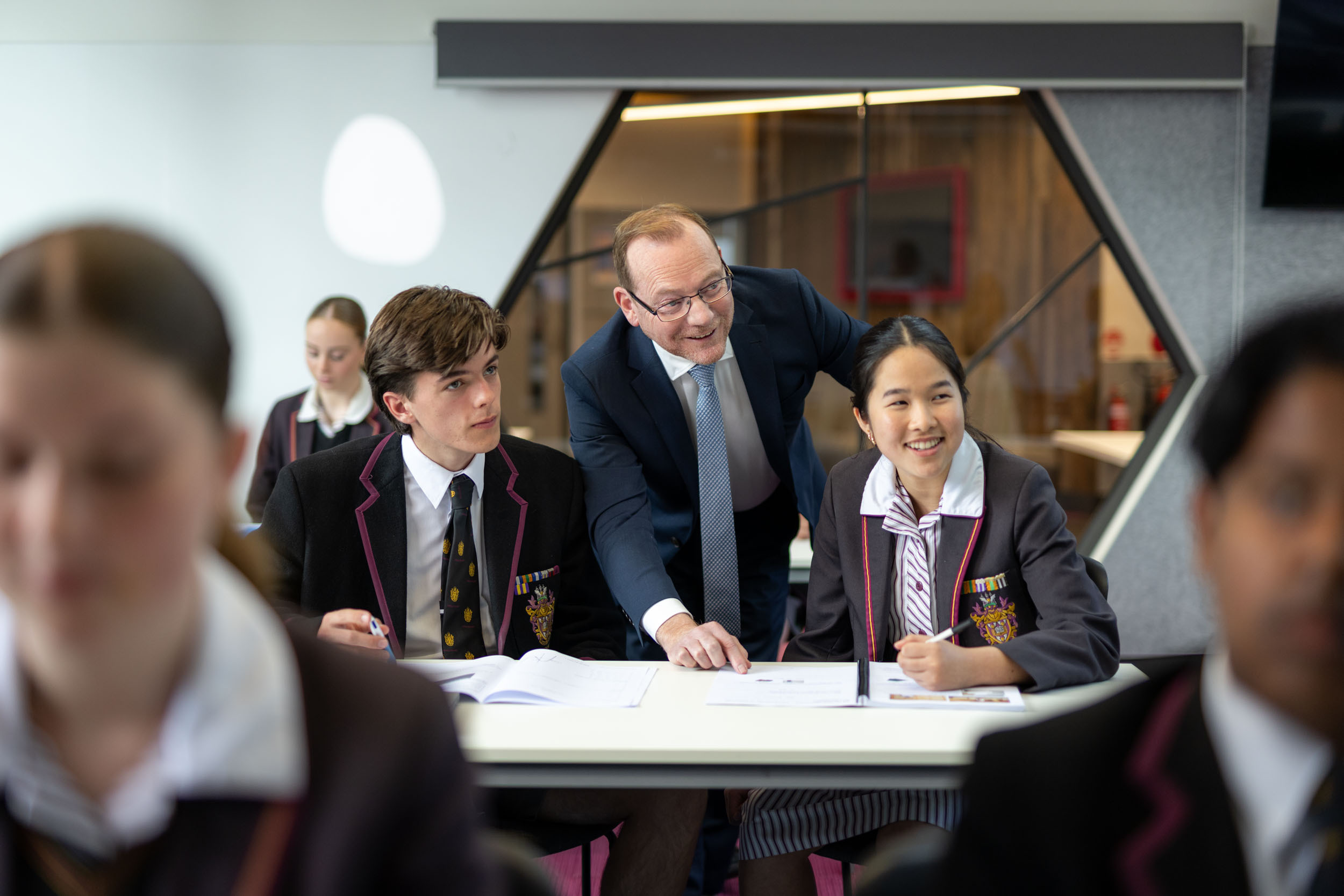
As education becomes increasingly global, the professional learning of teachers is evolving. Increasingly, some of the most valuable insights come from collaboration between educators working in different cultures and school systems. Programs like this allow teachers to share ideas, challenge assumptions and learn through different educational perspectives.
The mentoring partnerships support schools across Asia Pacific to deliver the internationally-recognised Victorian Certificate of Education (VCE) – offering students a valuable gateway to studying at domestic and international universities in their home country or overseas.
Through one-on-one mentorship, teachers learn the structure and content of the VCE, and are trained to deliver and assess the curriculum in their own school. Jason works with mathematics teachers to help them deliver the VCE maths curriculum across a number of subjects.
“I have regular online meetings with the teachers I mentor and we share our teaching experiences, set shared goals and discuss challenges. I help them to establish programs within their own schools for the VCE,” he says.
“The experience has introduced me to new teaching ideas and solutions and I’ve built collaborative and professional networks globally. It has been very rewarding academically and culturally to support other teachers and their professional journeys.”
From one school to many
Haileybury’s international mentorship and collaboration began in 2002 with one school in China. More partnerships with schools operating in large and smaller cities across the country followed, including with Haileybury’s flagship school, Haileybury Tianjin, which instead of the VCE delivers the South Australian Certificate of Education or SACE.
For years, teachers in Melbourne and Darwin have also mentored and supported colleagues in schools in Vietnam and in Dili in Timor Leste to deliver the VCE curriculum. This year, the mentoring program also was launched at Southbridges International School in Port Moresby, Papua New Guinea.
“Port Moresby is rapidly developing and PNG is an important neighbour. The school we have partnered is a decade old and small, but growing. They now have a senior school and approached Haileybury as they wanted to work with us to offer the VCE,” says Dr Stephan Muller, Deputy Principal (Experiential Learning & International).
New programs have also been launched at schools in Bandung and Surabaya in Java, Indonesia - both are established, larger schools that now offer the VCE curriculum to their senior students.
Transnational education in action
The transnational education program brings to life Haileybury’s vision to be ‘recognised as a great world school’ and to share its expertise and resources with the wider educational community.
“One way to be a great world school is to go out into the world and to work with the world, and to learn from those relationships”Dr Stephan Muller, Deputy Principal (Experiential Learning & International)
“This is very much transnational education in action – not international education. We are working with high-quality local schools that are embedded in their communities and who want to open a diversity of pathways for their students.
“The teachers are very experienced in their own subjects and in their own teaching and learning systems. We simply bring a different way of thinking about pedagogy and bring the critical thinking and analytical skills required in the VCE or the SACE to educators and students in ways that will prepare them well for their future pathways.”
Broadening horizons for K-to-12
Haileybury is intent on sharing its expertise in other countries and a number of nations have shown interest in the Haileybury’s teachers in Melbourne and Darwin supporting colleagues in other countries that want to offer the Australian curriculum. An active growth and diversification strategy is in place, says Stephan.
Plans are also under way to extend the program across K-to-12, allowing schools overseas to not only tap into the experience and resources of Haileybury’s highly-experienced senior school teachers, but also those that work within the ELC, Junior and Middle Schools.
The benefits for participating schools are many.
Students have diverse future pathways and greater opportunities at home and overseas as they graduate with a globally recognised certificate that can take them anywhere in the world. They also join Haileybury’s truly global 22,000-strong alumni network.
Teachers deepen their skillset and their professional networks and there are also opportunities for students and teachers to visit each other reciprocally.
Two-way learning
Haileybury staff and students also richly benefit from the transnational connections and partnerships.
“Mentoring others is a powerful professional learning tool that leads our teachers to reflect deeply on their own practice and pedagogy – what they do, how and why. The ecosystem of professional development that comes with these partnerships is high- impact,” says Stephan.
“We all have something to learn from the world around us. As a school, this makes us an interculturally aware, globally competent institution that can readily adapt to a rapidly changing world of education.”
In a world where education systems are becoming increasingly interconnected, schools that collaborate beyond their borders will be better placed to evolve, innovate and prepare students for a global future.


In the spirit of reconciliation, Haileybury acknowledges the Traditional Custodians of country throughout Australia and their connections to land, sea and community. We pay our respect to their elders past and present and extend that respect to all Aboriginal and Torres Strait Islander peoples today.
Type on the line above then press the Enter/Return key to submit a new search query
